What Is Apigenin? The Chamomile Compound Behind the Calm
What Is Apigenin? The Chamomile Compound Behind the Calm
Apigenin is a plant flavone (4′,5,7-trihydroxyflavone, C15H10O5) found in chamomile, parsley and celery. It became a sleep supplement after Andrew Huberman put roughly 50 mg of it in his bedtime stack. The catch: as of early 2026, no published human trial has tested an isolated apigenin capsule at that dose for sleep. What we have is animal research and chamomile studies.

By Chester Takau · October 2026
Why is apigenin linked to chamomile?
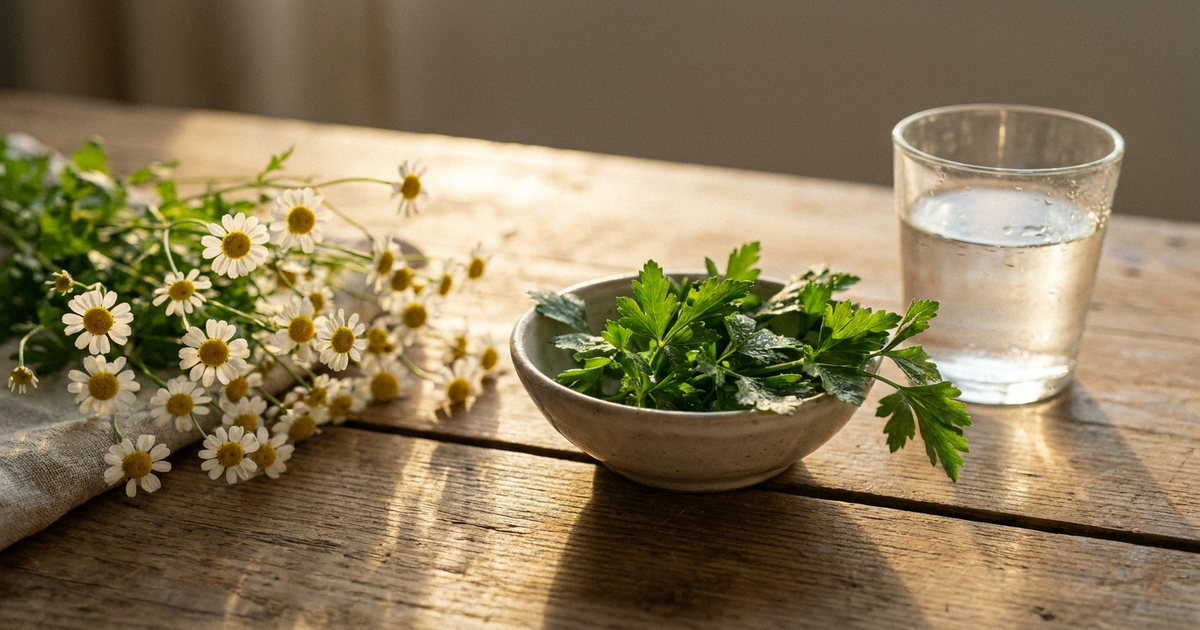
Chamomile is its best-known source, and apigenin is the compound most often credited for the herb's calming reputation. That credit is mostly an inference. Most pages jump straight to “for sleep” without saying that the same molecule also sits in everyday foods, or that its poor water solubility and low bioavailability are described in a 2026 review in Exploration of Foods and Foodomics as the main barrier to clinical use. A capsule and a cup of tea are not the same thing, and I could not find a source that clearly compares how much apigenin each delivers.
What does the evidence actually show?
Think of it as a ladder. The higher the rung, the more it tells you about people.
Apigenin evidence ladder
| Rung | What exists | What it can’t tell you |
|---|---|---|
| Isolated apigenin, human RCTs | None published for sleep or anxiety at ~50 mg (as of early 2026) | Whether the capsule works |
| Chamomile trials | A 2024 meta-analysis of 10 trials (n=772): sleep quality improved, but duration, efficiency and daytime functioning did not | Whether apigenin is the active part; results varied a lot (I² 88.4%) |
| Animal studies | Anxiolytic and antidepressant effects in rodents; longer sleep with magnesium in mice | Anything about human dose or effect |
On the chamomile rung, a 2024 pooled analysis by Kazemi and colleagues in Complementary Therapies in Medicine found a better sleep-quality score (PSQI weighted mean difference −1.88). A smaller pilot RCT of 34 adults found 270 mg of chamomile extract twice a day did no better than placebo for chronic insomnia, according to a Healf explainer from October 2025.
On the animal rung, a May 2026 systematic review in the Iranian Journal of Pharmaceutical Research covered 21 preclinical studies and reported “substantial antidepressant and anxiolytic effects” in rodents, with no human data. A 2026 Food & Function mouse study found apigenin plus magnesium lengthened sleep by 44% in normal mice, 32% in caffeine-disturbed mice and 37% in insomnia-model mice, more than either alone. That is a mouse result. It does not show a human would sleep 44% longer. In October 2026, a Frontiers in Pharmacology paper named GPR30 as a likely direct target and reported better cognitive scores in aging-model mice, but it used only male mice and did not measure amyloid or tau.
What do the experts say about the 50 mg dose?
Rhonda Patrick, who reviewed Huberman’s stack, is blunt about the gap. In her clip on whether these sleep supplements work, she says:
"There's really scarce data on apigenin's effects on improving sleep."
The 50 mg figure itself is disputed. Healf says the popular bedtime-dose instruction of about 50 mg comes from a manufacturer’s decision, not from a dose tested for insomnia, so this page does not recommend any dose (check with a doctor or pharmacist before using it), and another source notes it is far above the amount in chamomile extract. Vendors also disagree on how it works: some call purified apigenin a dose-dependent sedative (from animal data), others say it does not directly cause drowsiness and mainly eases pre-sleep anxiety. Huberman disclosed a Momentous sponsorship, and scientists have criticised him for promoting supplements on weak evidence, with apigenin a frequent example.
Who should be careful with apigenin?
Rhonda Patrick considers it unlikely to be harmful but unproven. Still, the cautions are scattered across sources, so here they are together:
- Warfarin: chamomile contains coumarins; ask a pharmacist.
- Sedatives and alcohol: effects may add up. Our guide to what skullcap herb is raises the same stacking question for another calming herb.
- Ragweed or other daisy-family allergy: chamomile belongs to the same plant family.
- Pregnancy and upcoming surgery: talk to a clinician first.
- Estrogen questions: a Huberman-site AI summary notes it can act as an estrogen inhibitor; long-term safety is not established.
Reported side effects, mostly from vendor sources, include vivid dreams, next-day grogginess and mild digestive upset. Dr Brighten says vivid dreams are not a common effect, so treat those reports as individual.
Sources
- Kazemi et al. 2024: chamomile sleep meta-analysis (10 RCTs, n=772)
- Food & Function 2026: apigenin + magnesium sleep study in mice
- May 2026 systematic review: apigenin for depression and anxiety (preclinical)
- Frontiers in Pharmacology, Oct 2026: apigenin mechanism and cognition in mice
- Exploration of Foods and Foodomics 2026: apigenin bioavailability review
- Apigenin: A Bioflavonoid with a Promising Role in Disease Prevention and Treatment
- FoundMyFitness: Rhonda Patrick’s sleep supplement review with transcript
- Healf: apigenin for sleep explainer
- Sacred Lotus: apigenin practice page (cautions)
Updated October 2026.
Transparency note: This article was researched and written by Chester Takau with AI assistance for research gathering and drafting. All recommendations reflect the author's own editorial judgment.
Comments
Post a Comment