FDA Regulation of Sleep Supplements: What the FDA Checks and What It Doesn't
FDA Regulation of Sleep Supplements: What the FDA Checks and What It Doesn't
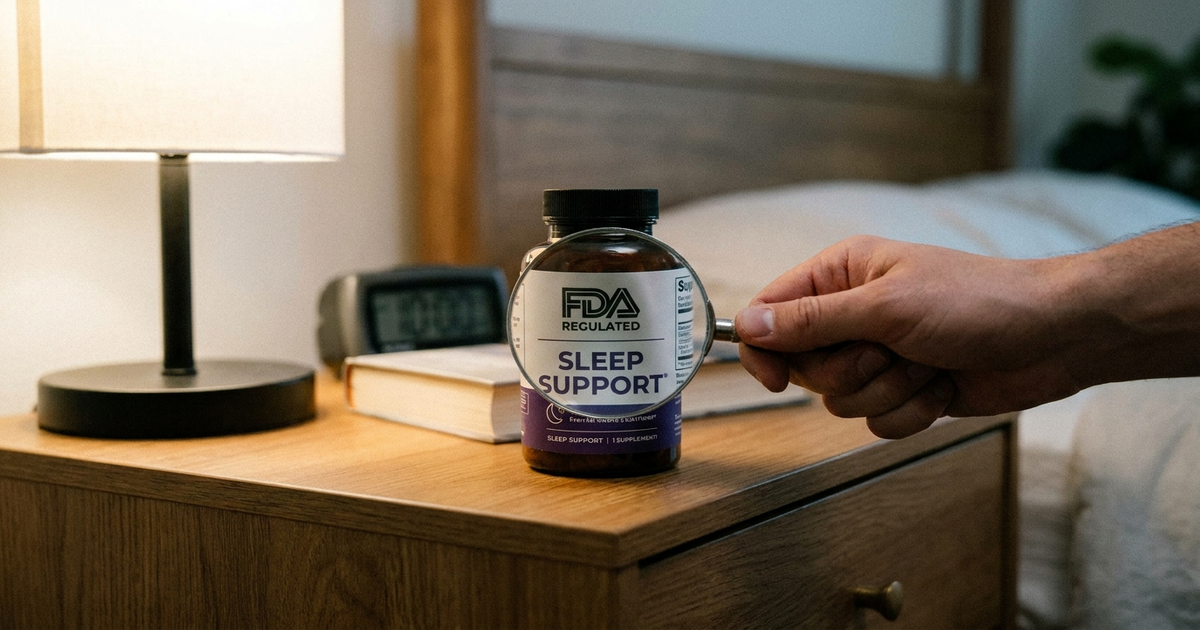
In the US, the FDA does not approve sleep supplements before they are sold. Companies are responsible for making sure a product is safe and labeled truthfully, and the FDA mostly steps in afterward, by inspecting facilities, issuing warnings and requesting recalls. So "unregulated" is wrong, but "FDA-checked" is wrong too. The agency sets manufacturing rules and can act on problem products, yet nobody verifies the dose in your melatonin gummy before it reaches the shelf.
By Chester Takau · November 2026
What the FDA does before and after a supplement is sold
Dietary supplements, including melatonin, valerian, magnesium and ashwagandha, fall under the 1994 Dietary Supplement Health and Education Act (DSHEA), not the drug rules. The practical difference is the order of events.
| Question | Sleep drug (prescription) | Sleep supplement |
|---|---|---|
| FDA approval before sale? | Yes, safety and effectiveness reviewed | No |
| Who proves it is safe? | The manufacturer, to the FDA | The manufacturer, on its own; the FDA must show a product is unsafe to remove it |
| Manufacturing rules? | Yes | Yes, supplement-specific good manufacturing practice (GMP) rules |
| Claims | Must be proven for the approved use | "Supports sleep" style claims allowed; may not claim to treat insomnia; label carries an "not evaluated by the FDA" disclaimer |
| New ingredients | Full approval | Ingredients not sold before 1994 need a New Dietary Ingredient (NDI) notification, and the FDA reviews the safety evidence |
| Problem found later | FDA can withdraw approval | Warning letters, public notices, recalls, seizures |
The 2026 enforcement record shows the pattern. In late October the FDA renewed a warning about "Green Lumber" after more samples tested positive for undeclared tadalafil, and listed a recall of a male-enhancement supplement for undeclared sildenafil, tadalafil and dapoxetine. Those are not sleep products, but each was a case of a product already on sale being pulled back.
"Unregulated" versus "that's a myth"
Both camps are partly right. Doctors quoted by Sermo describe melatonin as not fully regulated, and Live Science quotes experts saying it is "being promoted like there's absolutely no risk." The industry group CRN calls "unregulated" the biggest myth and points to GMP rules, facility registration and FDA oversight of ingredients. The accurate middle: there are rules, but they work after the fact, and nobody tests your specific bottle for you.
Does the label dose match what is inside?
Often not, and melatonin is the best-documented case. A 2023 JAMA study found 22 of 25 melatonin gummies mislabeled, with 1.3 to 13.1 mg per serving; one contained CBD and no melatonin. An earlier study of 31 products, summarized by StatPearls, found actual content from 83% below to 478% above the labeled dose. A Mayo Clinic video makes the related point about assuming safety from the shelf:
As Mayo Clinic's Dr. Naima Covassin puts it near the end of the segment:
"Because something is marketed as 'natural' or a product is sold over the counter doesn't mean it's harmless."
Quote note: the wording was checked against Mayo Clinic's published script as syndicated by the News Tribune, not the video captions. The segment dates from 2022.
What label terms actually mean
| Label wording | What it tells you | What it does not tell you |
|---|---|---|
| "FDA approved" | Should not appear on a supplement; it is a red flag | Supplements are not approved. Prescription melatonin-receptor drugs, such as those StatPearls lists, are a different product class. |
| "FDA registered facility" | The plant is on the FDA's facility list | Registration is not an inspection or an endorsement of the product |
| "Made in a GMP facility" | The maker says it follows manufacturing and testing rules | The FDA may not have inspected it recently; mislabeling studies still found problems |
| USP, NSF or ConsumerLab seal | A private group tested or audited the product | Not a government check; each program has its own scope, so read what the seal covers |
| "Natural" | Nothing standardized for safety | Whether it interacts with medicines or alcohol |
That last point matters for herbs. Whether a sedating herb is "natural" tells you nothing about mixing it with a drink, which is why it is worth asking a doctor or pharmacist about any combination with alcohol.
Can a "natural" sleep aid hide a drug?
It can happen, and the FDA's public list is how many cases surface. The "Sleep, Skin, Bodybuilding and Other Product Notifications" page was still being updated in June 2026 (latest entry PRE-FORMANCE BLACK, 6/24/2026), but its newest sleep entries are older: bio LIT in February 2025 and Agebox iKids in September 2025. A quiet list does not prove clean shelves. It records what has been found, and detection is mostly reactive, so products sold online by unregistered sellers are the highest-risk group. You can search the list before buying something unfamiliar.
The 2026 rule changes, in plain English
- Self-affirmed GRAS would end (proposed 2026-08-11). Today a company can decide on its own that an ingredient is "generally recognized as safe" without telling the FDA. The proposed rule (91 FR 51834, Docket FDA-2025-N-3262) would make notifying the FDA mandatory. Comments are due 2026-12-09. It is aimed at food ingredients, so its direct effect on herbs sold as supplements is limited, but supplement makers also use GRAS ingredients such as excipients and flavors.
- Final NDI guidance (issued 2026-10-19). For a new ingredient, companies are told to document the manufacturing process, specifications, analytical methods and impurities or contaminants. That affects new compounds more than long-sold herbs like valerian.
- Dietary Supplement Listing Act of 2026 (H.R. 8370, introduced 2026-04-20). It would create the first mandatory FDA listing of each product, with its label, ingredients and claims. It is a bill, not law.
- Leadership change. Commissioner Marty Makary resigned on 2026-05-12, and Kyle Diamantas, the deputy commissioner for food, became acting commissioner. Supplements sit on the food side. I found no reporting yet on what this means for enforcement, so treat any prediction as speculation.
- Scope of "dietary substance" (public meeting 2026-03-27). The FDA asked for input on what counts as a dietary ingredient under DSHEA. Industry welcomes a broader definition; critics worry about weaker oversight.
The direction is mixed: stricter on notification, with parts of the industry also pushing for deregulation. None of it changes today's rule that your bottle is not checked before it is sold.
Why melatonin is a supplement here and a medicine elsewhere
The UK, EU and Australia classify melatonin as a medicine, available by prescription, while in the US it is sold as a supplement. That is a legal classification difference, not a finding that the US version is safer or more effective. It also explains the dose pattern people notice: many US pills are 3 to 10 mg, though studies suggest roughly 0.3 mg can work. In a related finding, an AHA 2025 conference abstract of about 130,800 adults with insomnia linked long-term melatonin use to higher heart-failure risk (5% versus 3%). It shows association only, was not peer-reviewed at the time, and critics note that people with insomnia already carry more cardiac risk. It is a reason to ask a doctor about long-term use, not proof of harm.
Herbal and mineral sleep aids are covered by the same framework. Interaction questions are a good example of why this matters: see our 5-HTP and SSRI interaction warning, and check with a doctor or pharmacist before combining any supplement with a medicine. For melatonin specifically, our article on melatonin tolerance and dependence covers long-term use.
Frequently asked questions
Are any sleep supplements FDA approved?
No. Supplements are not approved. Prescription sleep drugs, including some that act on melatonin receptors, are approved, but they are a separate category.
Is it safe to give kids melatonin gummies because they are "just a supplement"?
Being a supplement says nothing about safety. Pediatricians have objected to an untested product spreading among parents, and CDC data show pediatric melatonin ingestions rising. Ask your child's doctor first, and keep gummies stored like medicine.
Where do I report a bad reaction?
To the FDA through MedWatch or the Safety Reporting Portal, and also to the company. Keep the bottle, lot number and a note of the dose and timing. Tell your doctor or pharmacist as well.
How can I lower the risk of buying a mislabeled product?
Choose products with an independent testing seal and check what the seal covers, avoid unregistered online sellers, and search the FDA's tainted-product list for the brand. None of these is a guarantee.
Sources
- FDA: Sleep, Skin, Bodybuilding and Other Product Notifications
- Federal Register: Substances Generally Recognized as Safe (proposed rule, 2026-08-11)
- FDA: Dietary Supplements Guidance Documents & Regulatory Information
- Nutritional Outlook: final NDI guidance (2026-11-03)
- StatPearls / NCBI: Melatonin
- STAT: Makary resigns, Diamantas acting (2026-05-12)
- Council for Responsible Nutrition: melatonin facts
- Live Science: should melatonin be considered a drug?
- CDC MMWR: pediatric melatonin ingestions
- ACC: melatonin and heart failure, AHA 2025 abstract
- Epstein Becker Green: Dietary Supplement Listing Act of 2026
Updated November 2026. Rules and proposals change; check the FDA and Federal Register pages for current status.
Transparency note: This article was researched and written by Chester Takau with AI assistance for research gathering and drafting. All recommendations reflect the author's own editorial judgment.