L-Theanine Dosage and Timing: How Much to Take and When It Actually Kicks In

L-Theanine Dosage and Timing: How Much to Take and When It Actually Kicks In

By Chester Takau · August 2026

Short answer

200 to 450 mg a day, taken 30 to 60 minutes before you want the effect. That range comes from a 2025 systematic review of 13 standalone L-theanine trials (n=550). Plasma levels peak around 30-50 minutes after you take it and its half-life is roughly 60-75 minutes, which is why timing it loosely — "sometime before bed" — wastes most of what the dose can do. For sleep specifically, a separate 2025 meta-analysis of 19 studies found it reliably improves how sleep feels (falling asleep faster, less next-day grogginess) without measurably changing sleep on objective trackers — a distinction almost nothing else written about it mentions upfront.
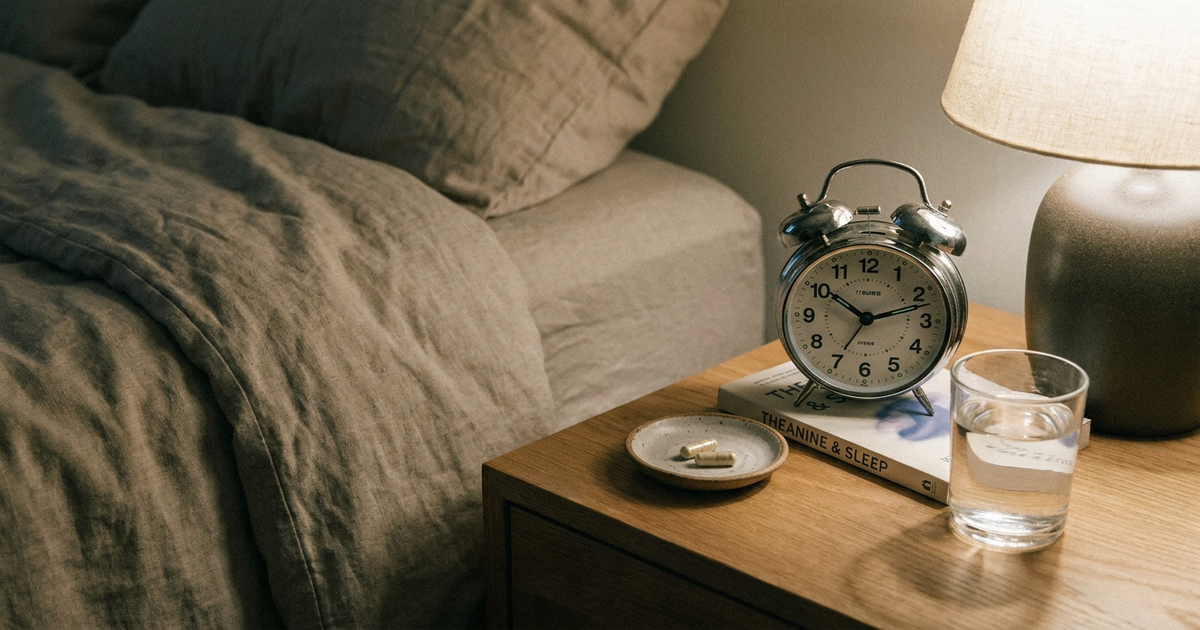
A measured dose of L-theanine capsules next to a bedside clock, representing L-theanine dosage and timing before bed
Chester Takau is an independent researcher covering natural sleep remedies for NaturalSleepHerbs, focused on herb safety, dosing, and interactions. Content is educational and not a substitute for advice from a doctor or pharmacist. More at the about page.

Plan your dose and take-by time

Pick your goal and target time. This uses the peak/half-life numbers above to work backward to when to actually take it — not just "before bed."

L-Theanine Dose & Timing Planner

Uses the published peak (~30-50 min) and half-life (~60-75 min) window to calculate when to take it.

General guidance based on published dose ranges, not medical advice. Doses above 450 mg/day haven't been consistently studied for extra benefit — check with a doctor or pharmacist before combining with medications, especially blood pressure drugs or stimulants.

How much is actually enough — 200 mg or 400 mg?

A September 2025 systematic review pooling 13 standalone L-theanine trials, spanning doses from 50 to 900 mg per day, landed on 200-450 mg/day as the range with consistent, safe support for sleep in adults (Tandfonline, Sep 2025). 200 mg is the floor where most people notice something; 400 mg is roughly where the reviewed studies stop showing a meaningfully bigger effect for extra milligrams. If you're new to it, start at 200 mg rather than assuming more is automatically better — the trials didn't find a strong dose-response curve above that point, they mostly found the same modest benefit repeated at higher numbers.
A measured dose of L-theanine capsules next to a clock reading 45 minutes before bedtime, deep blue night-lit gradient

Dose by goal

Goal Dose Timing
Sleep onset200-400 mg30-60 min before bed
Focus (with caffeine)200 mg theanine : 100 mg caffeine~40 min before the task
Acute stress200 mgAs needed

The honest part: it changes how sleep feels, not what your tracker shows

Most articles selling L-theanine for sleep skip this. A 2025 meta-analysis of 19 studies (n=897) found it significantly improved subjective sleep onset latency, daytime dysfunction, and overall sleep quality — but did not produce a measurable change on objective sleep measures like actigraphy or polysomnography (ScienceDirect, 2025). Coverage of the same Bond University review put it plainly: the benefit is mainly in how sleep feels, not in measured sleep architecture (NutraIngredients, Mar 2025). That's not the same as placebo — perceived sleep quality is a real, clinically meaningful outcome, and it lines up with the mechanism: theanine calms mental hyperarousal through GABA, serotonin, and dopamine modulation rather than sedating you, which is why it shortens how long falling asleep feels without necessarily showing up as a bigger change on a sleep tracker (Sleep Science, Jun 2026). If you want something a tracker will register as faster sleep onset, that's a different mechanism, closer to how traditional versus instant kava preparation changes how quickly it sedates you. Theanine isn't trying to be that.

Andrew Huberman covers the mechanism and dosing directly in this clip:

Does it stop working if you take it every night?

This is genuinely contested. Most consumer sources repeat "no tolerance, no dependence, no withdrawal" as settled fact. Community and harm-reduction reporting disagrees — sources tracking regular users describe tolerance building with nightly use, needing roughly 5 days of reduced dosing to halve it and about 10 days off to fully reset (PsychonautWiki). There's no large controlled trial settling this either way. The practical middle ground: if 200-400 mg stops doing much after a few months of nightly use, that's a plausible sign of tolerance, not a sign you need a bigger dose. Cycle off for about a week every two to three months and reassess, rather than climbing toward 600-900 mg chasing an effect that a tolerance break might restore for free.

Is a higher dose — 600-900 mg — worth it?

The 2025 standalone-trial review covered doses up to 900 mg/day, and the safety data at that level is fine, but the effectiveness case for going past 450 mg is thin (Tandfonline, Sep 2025). A separate 2025 meta-analysis on cognition described the overall evidence as "promising, but not completely conclusive" — real but modest effects across placebo-controlled trials, not a dose-dependent ramp (PMC, 2025). Unless you have a specific reason to test a higher dose under guidance, 200-400 mg captures most of what the research supports.

Who should skip it at bedtime

The most common bedtime complaint isn't grogginess — it's unusually vivid or disturbing dreams. Andrew Huberman's own guidance on this, given on The Tim Ferriss Show, is direct: "If your dreams are too vivid, drop the theanine."

"If your dreams are too vivid, drop the theanine."

If that's you, dropping to 100-200 mg or moving your dose earlier in the evening usually resolves it. People prone to sleepwalking or night terrors should avoid taking it at bedtime altogether, since more vivid dream recall and REM changes are exactly the wrong direction for those conditions.

Empty stomach, food, and stacking with other supplements

Food doesn't meaningfully block absorption, but taking it on an empty stomach gets you closer to the studied 30-50 minute peak; with a full meal, absorption can lag by 15-20 minutes, which matters if you're timing it tightly against bed. Stacking with magnesium is common and unproblematic — they work through different pathways, and how magnesium compares against valerian and kava as a sleep aid covers the magnesium side if you're deciding what to pair it with. Melatonin is a different story: it's a circadian signal, not a calming agent, so combining it with theanine targets two separate problems rather than doubling up on one. Layering in apigenin on top, as some 2026 stacks do, is more about additive convenience than necessity — reasonable, not required.

FAQ

Can I take it both morning and night?

Yes — a lot of people use a small focus dose with morning coffee and a separate sleep dose at night. Just keep the daily total inside 200-450 mg unless you've discussed higher amounts with a doctor.

30-60 minutes before bed, or 1-2 hours?

30-60 minutes is what the pharmacokinetics actually support. The "1-2 hours" advice floating around online doesn't match the ~30-50 minute peak — by two hours out, a meaningful share of the dose has already cleared.

Is 900 mg dangerous?

The reviewed trials didn't flag safety issues up to 900 mg/day, but nothing above 450 mg showed a clearly bigger benefit, so there's little upside to going that high routinely.

Sources: ScienceDirect meta-analysis, 2025 · Tandfonline systematic review, Sep 2025 · PMC cognition meta-analysis, 2025 · NutraIngredients, Mar 2025 · Healthline overview
Updated August 2026.

Transparency note: This article was researched and written by Chester Takau with AI assistance for research gathering and drafting. All recommendations reflect the author's own editorial judgment.
Glycine for Sleep: Does This Amino Acid Actually Help You Rest?

Glycine for Sleep: Does This Amino Acid Actually Help You Rest?

By Chester Takau · August 2026

TL;DR

Yes, modestly. A 3-gram dose of glycine before bed has real mechanistic and clinical support — it lowers core body temperature, calms the nervous system through NMDA receptors, and preserves normal sleep architecture instead of sedating you the way a sleeping pill does. The catch: the evidence base is thin, every published human trial used roughly the same 3g dose, and much of the foundational research traces back to funding from Ajinomoto, the company that manufactures glycine. Judge it over one to three weeks, not one night.

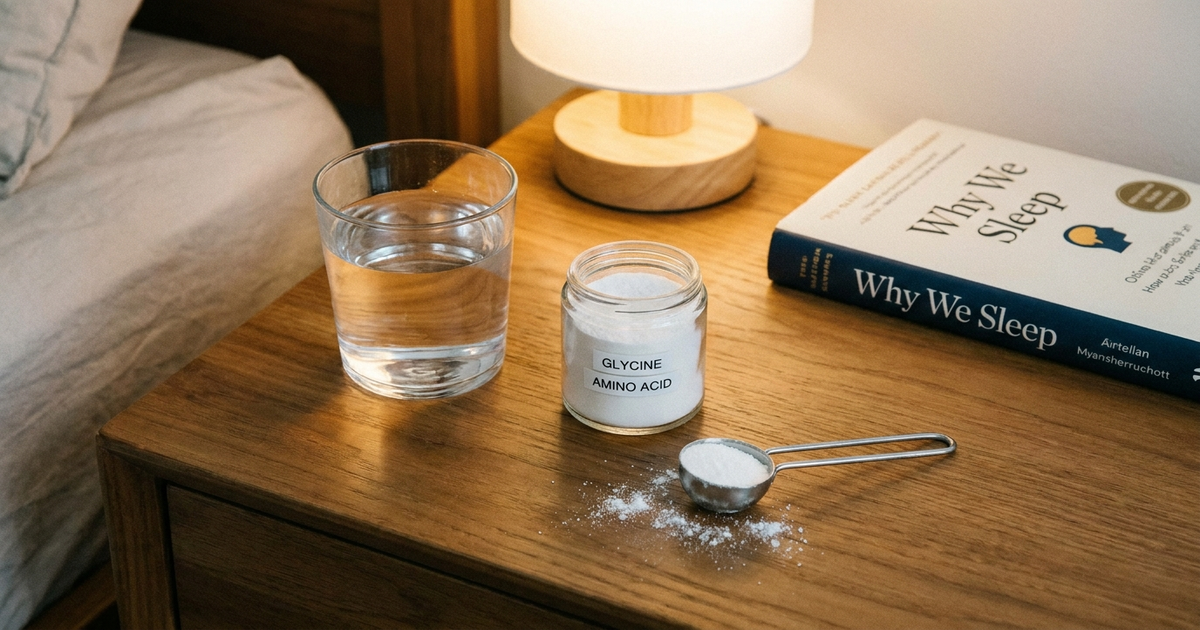
Glycine powder and a measuring scoop beside a glass of water on a nightstand, representing glycine as an amino acid sleep supplement

Does glycine actually work, or is this just supplement hype?

Unlike most sleep herbs, glycine isn't a plant extract — it's a non-essential amino acid your body already makes, sold as a plain powder or capsule. A clinical review published by GlobalRPH in October 2025 lays out three separate pathways: thermoregulation, neurotransmitter modulation, and circadian support, and notes that glycine appears to preserve natural sleep stages rather than knocking you out the way a sedative does (GlobalRPH, October 2025). That's a genuinely different profile from a fast sedative — if you want something that works within the hour rather than gradually, that's closer to how kava behaves, and how kava's preparation method changes how fast it sedates you is worth knowing before you compare the two head-to-head.

The skeptical case is worth taking seriously too. WinAging puts it bluntly: "well tolerated" and "proven to work" are different bars, and glycine clears the first one far more convincingly than the second (WinAging). A lot of the mechanism evidence comes from rat studies, and the human trials backing glycine for sleep are small and short. Sleep Foundation's current guide agrees: benefits show up in "some healthy people," but the studies carry a real risk of bias since most rely on self-reported sleep quality rather than objective measurement (Sleep Foundation). And there's a conflict-of-interest wrinkle that rarely gets mentioned: much of the foundational human research traces back to funding from Ajinomoto, the glycine manufacturer (Midi Health, 2026). None of that means glycine doesn't work. It means the evidence is real but thin, and anyone telling you it's a settled, slam-dunk sleep aid is overselling a modest, industry-adjacent dataset.

The mechanism: why your hands and feet feel warm after taking it

Glycine acts as a co-agonist at NMDA receptors in the suprachiasmatic nucleus — the part of your brain that runs your circadian clock — which is the piece that links its timing effect to its temperature effect (Dr. Kumar Discovery, 2025). In practice, that shows up as a specific, measurable pattern: thermal-imaging research from Doctronic found that glycine raises skin temperature in the hands and feet within about 30 minutes of taking it, while core body temperature drops (Doctronic, 2026). That extremity-warming, core-cooling swap is the same signal your body sends itself right before natural sleep onset — glycine appears to nudge that switch a little earlier and a little more reliably. If you take it and notice warm hands and feet at bedtime, that's not a side effect to worry about; it's the mechanism working as described.

For a walkthrough of glycine's role in nighttime recovery, the video below is a recent, on-topic explainer worth watching before you decide whether to add it to your routine.

How much to take, and how long before you notice anything

Every published human trial on glycine for sleep has landed on roughly the same dose: 3 grams, taken 30 to 60 minutes before bed. That consistency cuts both ways — it's a stable, repeatable finding, but it's also a thin evidence base built on the same number over and over rather than a range of dose-response data. Set your expectations accordingly: this is not a knockout pill. The reported effect is gradual, and most people who notice a difference describe it building over one to three weeks of nightly use rather than the first night. Research interest in glycine hasn't slowed — a clinical trial completed in June 2026 tested glycine supplementation for cognitive performance in older adults, a sign the amino acid is being studied well beyond just sleep (ClinicalTrials.gov, June 2026).

Glycine vs. magnesium glycinate: these are not the same supplement

This mix-up is common enough to deserve its own answer. Plain glycine is the amino acid itself, taken at the 3g dose the sleep studies use. Magnesium glycinate is a magnesium salt bonded to glycine molecules purely to improve absorption and reduce stomach upset — the glycine content in a typical dose is far below 3g, so it's riding along as a delivery vehicle, not functioning as a standalone sleep dose. If you're deciding between the two, or wondering whether to stack them, how to choose the right magnesium type and dose covers the magnesium side of that question in detail. Taking both together nightly is common and there's no known interaction working against you — you'd simply be covering two separate mechanisms, magnesium's role in GABA and muscle relaxation alongside glycine's NMDA and thermoregulation pathway.

Is it safe every night? Side effects and dependency

Glycine powder and a measuring scoop beside a glass of water on a nightstand, deep blue night-lit gradient

Across the published trials, glycine shows no meaningful dependency or rebound insomnia pattern the way melatonin sometimes does with long-term nightly use. The most common complaint is mild digestive upset, and it's uncommon at the standard 3g dose. Some users report unusually vivid dreams, which lines up with glycine's role in sleep architecture — if it's genuinely supporting more normal REM cycling rather than suppressing it, more memorable dreaming is a plausible side effect rather than a red flag. There's no evidence of morning grogginess, which is one of the more consistently repeated points across sleep-aid reviewers: glycine doesn't leave the hangover-like fog that sedating antihistamines or high-dose herbal sedatives sometimes do.

Does it help with perimenopause night waking and hot flushes?

This is one of the more promising and least-covered angles. Because glycine's core mechanism is lowering internal body temperature, 2026 coverage has started connecting it to perimenopause and menopause-related night waking and hot flushes, where core temperature swings are a direct driver of disrupted sleep (Midi Health, 2026). The honest caveat: no glycine trial has been run specifically on women experiencing menopausal symptoms yet, so this is a mechanistic inference from the thermoregulation data rather than a proven, dedicated result. If hot flushes are waking you up and the core-cooling story lines up with your experience, it's a reasonable low-risk supplement to try — just don't expect trial-backed certainty on this specific use case yet.

Where glycine fits if you're still deciding what to try

Glycine's biosynthesis pathway is entirely different from a plant-based sedative or an adaptogen, which is exactly why it's worth considering alongside — not instead of — the herbal options most sleep content defaults to. For the fuller lay of the land, how valerian, kava, and magnesium stack up against each other as sleep aids is the broader comparison to read if glycine turns out not to be the right fit for how your sleep problem actually shows up.

The bottom line

Glycine has a real, mechanistically plausible effect on sleep onset through thermoregulation and NMDA-receptor activity in the circadian clock, and it does this without sedating you or disrupting normal sleep stages. But the human evidence is small, repetitive at a single 3g dose, and shadowed by industry funding — so treat it as a modest, well-tolerated tool rather than a proven cure. Take 3 grams 30 to 60 minutes before bed, give it one to three weeks before judging it, and don't expect it to feel like a sedative on night one.

Transparency note: This article was researched and written by Chester Takau with AI assistance for research gathering and drafting. All recommendations reflect the author's own editorial judgment.
Related on NaturalSleepHerbs: Smartwatch Sleep Tracking: 90 Nights of Real Data; What Is Hops (Humulus Lupulus) for Sleep? The Plain-Language Explainer; Holy Basil Tulsi for Sleep: What the Cortisol Research Actually Shows; Does Ashwagandha Make You Sleepy? What the Research Actually Says

Does Ashwagandha Make You Sleepy? What the Research Actually Says

Does Ashwagandha Make You Sleepy? What the Research Actually Says

By Chester Takau · July 2026

Short answer: mostly no, but not never. Ashwagandha isn't a sedative the way melatonin or a sleeping pill is — it works mainly by lowering cortisol and stress signaling, so sleep comes easier rather than getting switched off on contact. That's why most people describe it as "calming," not "sleep-inducing," despite what the name suggests. But drowsiness is officially listed as a common mild side effect by the NIH, and a real minority of users do feel genuinely sleepy, sometimes into the next morning. Whether that's you comes down to dose, sensitivity, and timing — here's the breakdown.

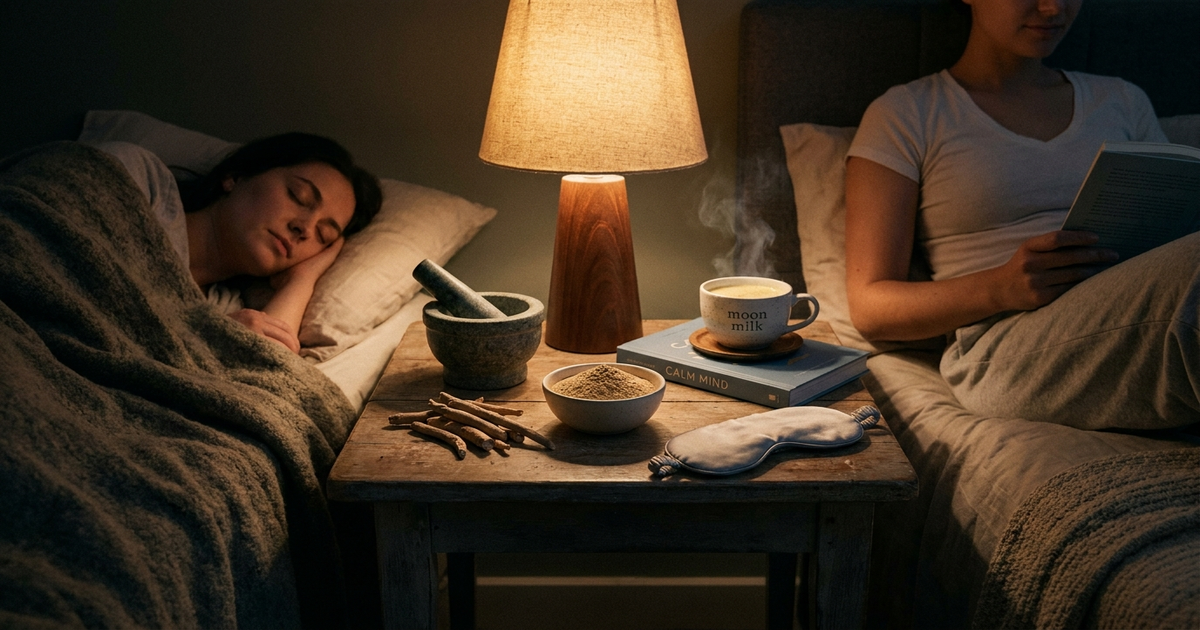
Ashwagandha root and powder beside a dimly lit bedside table, representing whether ashwagandha makes you sleepy or just calm

Group 1 — Most People

Calm, not sedated

The dominant expert framing, repeated across clinical and consumer sources, is that ashwagandha doesn't cause instant drowsiness like a sleeping pill. It lowers the evening stress load that was keeping you wired, and sleep improves as a downstream effect over roughly 6–8 weeks of consistent use — not the first night. If you take a standard dose and feel nothing more than "less anxious by bedtime," that's the herb working as intended for most users.

Group 2 — A Real Minority

Genuinely drowsy, and here's why

Sleep Foundation attributes part of ashwagandha's sleep effect to GABA-receptor activity on top of its cortisol-lowering action — a mild sedative-adjacent mechanism, not just stress relief. That's the piece most "it's not a sedative" articles leave out, and it explains why a documented subset of users do feel real drowsiness rather than calm. Higher doses, higher individual sensitivity to GABA-acting compounds, and taking it alongside other calming supplements all raise the odds you land in this group instead of Group 1.

Group 3 — Next-Day Grogginess

How to avoid the morning-after fog

Forum reports of feeling "hungover" the next morning cluster around three fixable variables: too high a dose for your body, taking it too close to your wake time, and leaf-inclusive extracts rather than root-only ones. If mornings feel foggy, drop back to a lower dose, move your dose earlier in the evening, and check the label for a root-only extract before assuming ashwagandha just isn't for you.

Does it work like melatonin?

No, and a March 2026 head-to-head trial makes the distinction clear. In an 8-week randomized study of 200 adults aged 18–50, researchers compared ashwagandha (300 mg twice daily), melatonin (3 mg), and the combination of both. All three cut sleep-onset latency, but the ashwagandha-plus-melatonin group showed the greatest improvement — suggesting the two work through different pathways rather than duplicating each other (PubMed, March 2026). Melatonin resets your circadian signal directly; ashwagandha lowers the stress chemistry standing in the way of sleep. That's also why ashwagandha's dosing window is more forgiving than a herb like valerian, where the valerian timing mistake that keeps people up is a strict before-bed-only problem — ashwagandha's cortisol-lowering action tolerates more flexible timing.

Morning or night: how to decide

If your main issue is daytime stress that follows you into bed, morning or afternoon dosing lets the cortisol-lowering effect build across the day. If you fall asleep fine but wake up wired at 3am, an evening dose 30–60 minutes before bed targets that window directly. A newly reported all-female study of the Shoden extract found benefits across stress, sleep, mood, and focus (NutraIngredients, May 2026), and a sustained-release formulation tested over 60 days improved both stress and sleep quality at 150 mg and 300 mg, with the 300 mg dose working faster (NutraIngredients, April 2026). Neither trial found a reason to insist on one fixed time — match the timing to which problem you actually have.

For a walkthrough of the clinical evidence behind the sleep claims, the video above reviews what the trials actually show before you decide whether ashwagandha is worth adding to your routine.

Is the sleepy feeling related to "emotional blunting"?

This overlap is rarely discussed directly, but it's worth separating. Some anecdotal reports describe ashwagandha causing apathy or a "flat" feeling, sometimes compared to an SSRI effect — distinct from drowsiness, though the two get conflated in forum threads. Practitioners note this isn't a doctor-acknowledged side effect and lacks clinical backing, unlike drowsiness, which the NIH does list as a recognized mild effect (NIH ODS fact sheet). If you feel sleepy and calm, that's the expected mechanism. If you feel numb or emotionally flat rather than calm, that's a different complaint worth flagging to a doctor rather than riding out.

The liver-safety question, and how long before it works

Australia's TGA reaffirmed in its 2025–2026 safety update that Withania somnifera products carry a "very rare" risk of liver injury; most cases resolved after stopping, though some needed treatment and four required hospitalization (TGA safety update). The Netherlands Pharmacovigilance Centre logged 12 liver-injury cases through June 2025. Set against that, a 2025 Frontiers in Nutrition meta-analysis of high-quality clinical-trial data found ashwagandha generally well tolerated with no adverse effect on liver, thyroid, or kidney function (Frontiers in Nutrition, 2025). The practical middle ground: expect the sleep benefit to build over weeks rather than one dose, choose root-only extracts, and if you're on it long-term nightly, that's a reasonable case for periodic liver-enzyme checks rather than either dismissing the case reports or panicking over them. Ashwagandha's gradual, cortisol-driven path to sleep is a different mechanism entirely from a direct sedative like kava, where how kava preparation changes its sedative strength is the whole story — there's no equivalent onset-speed question for a stress-modulating adaptogen.

Ashwagandha root and powder beside a dimly lit bedside table, deep purple-to-indigo gradient

Where ashwagandha fits among sleep herbs

Ashwagandha sits closer to an adaptogen than a sedative, which puts it in a different category from the GABA-direct herbs covered across herbal sleep remedies for modern insomnia. If you want something that works on contact, look at the sedative end of that lineup. If your insomnia is stress-driven and you can wait a few weeks for the effect to build, ashwagandha is one of the better-evidenced options for that specific problem.

The bottom line

For most people, ashwagandha won't make you sleepy in the way a sleeping pill does — it lowers the stress response that was keeping sleep away. For a real minority, GABA-receptor activity means genuine drowsiness, and next-day grogginess is usually a dose or timing problem rather than a reason to quit. Start low, take it consistently for several weeks before judging it, and pick a root-only extract if mornings feel foggy.

Transparency note: This article was researched and written by Chester Takau with AI assistance for research gathering and drafting. All recommendations reflect the author's own editorial judgment.

Medical disclaimer: This article is general information reflecting traditional use and published research — not medical advice. Supplement effects, doses, and interactions vary from person to person. Talk to a doctor or pharmacist before starting any supplement, especially if you are pregnant or breastfeeding, taking medication, or managing a health condition.