5-HTP Dosage and Safety: How Much to Take and When to Stop
5-HTP Dosage and Safety: How Much to Take and When to Stop
By Chester Takau · August 2026
Short answer
150-300 mg a day is the typical therapeutic range, and for sleep specifically most people need 200 mg or more, taken 30-45 minutes before bed. Start at 50 mg (25-50 mg if you're over 65) and increase every one to two weeks, not every few nights. Doses of 6-10 g/day are flagged "possibly unsafe" and linked to serious stomach and muscle problems — that's roughly 20-40x the top of the normal range, not a typo people accidentally hit, but it shows how wide the safety margin actually is at sane doses.
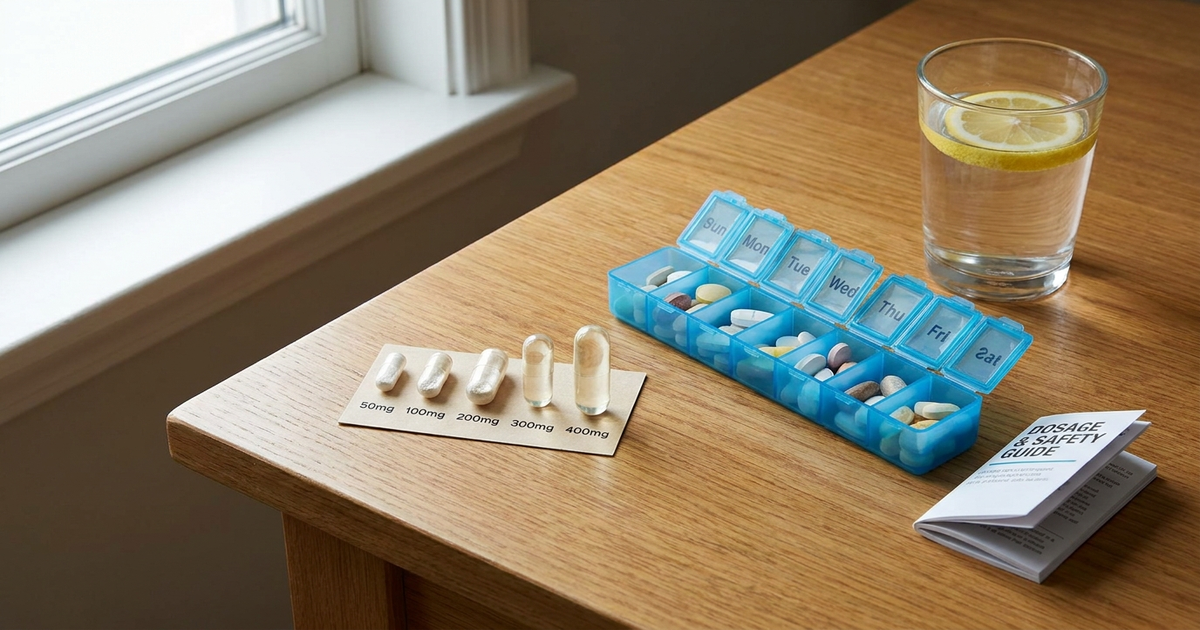
Build a titration schedule
Pick your goal and current week, and this lays out the next step — the "start low, go slow" approach most sources recommend but rarely turn into an actual schedule.
5-HTP Titration Planner
Enter your goal and how many weeks you've been taking it. This maps out the next step, not a full medical plan.
General guidance based on published dose ranges, not medical advice. Never combine 5-HTP with an SSRI, SNRI, MAOI, triptan, tramadol, or St. John's wort without talking to a doctor or pharmacist first, and stop it at least 24 hours before any scheduled surgery.
How much 5-HTP should I take for sleep, and when?
Research on 5-HTP for insomnia generally used 200 mg or more, taken 30-45 minutes before bed — below that threshold, many people don't notice a measurable difference (Neurolaunch, 2026). That's higher than the 50-100 mg starting doses common in general 5-HTP guidance, which is written mostly around mood, not sleep specifically. The practical version: start at 50 mg to check tolerance, then climb toward the 200 mg mark over a couple of weeks rather than jumping straight there on night one.
50 mg vs 100 mg vs 200 mg — where do I actually start?
| Dose | When it fits | What to expect |
|---|---|---|
| 50 mg | Week 1, or anyone over 65 | Tolerance check; often too low to change sleep on its own |
| 100 mg | Weeks 2-4, general use | Common mood-support dose; inconsistent for sleep |
| 200 mg+ | After titrating up, sleep-focused use | The threshold research actually tested for insomnia |
The 150-300 mg/day range is the one that shows up repeatedly in depression-focused studies and has been used safely for up to a year in that context (Biology Insights, 2026). Treat 300 mg as the practical ceiling for routine use rather than a floor to build up to — most people land somewhere between 100 and 200 mg once they've found what works.
This overview covers the dosage ranges and risk profile in more detail:
Can I take 5-HTP if I'm on an SSRI or other antidepressant?
This is the most-asked safety question, and the honest answer has two layers. Poison Control and most clinical sources warn against combining 5-HTP with SSRIs, SNRIs, MAOIs, triptans, tramadol, or St. John's wort, because stacking serotonin-raising substances carries a theoretical risk of serotonin syndrome (Poison Control, 2025). The nuance almost nobody mentions: as of the 2025 literature, no confirmed human case of serotonin syndrome from 5-HTP — alone or combined — has actually been documented (Droracle, 2025). That doesn't make the warning wrong; the mechanism is real and the consequences if it did happen are serious enough that "precautionary" is the right posture. It does mean the warning is a risk-management call, not a body count. Either way, the practical answer stays the same: don't self-combine, talk to a doctor or pharmacist first.
Why does 5-HTP give me such vivid dreams or nightmares?
5-HTP is a direct precursor to serotonin, which your brain also converts into melatonin and uses to regulate REM sleep — pushing more of it into that pathway tends to intensify dream recall and dream vividness, and higher doses correlate with stronger effects (Dream Studies, 2026). Most people find this pleasant or neutral; a smaller group gets genuine nightmares, especially at higher nighttime doses. If that's you, the fix is usually the same as with other serotonin-active sleep aids: drop back to the lowest dose that still helps, or take it slightly earlier in the evening.
Is 5-HTP banned? Why did it get pulled off some shelves?
5-HTP itself was never banned. The confusion traces back to 1989, when a contaminated batch of L-tryptophan — a related but different supplement — caused an outbreak of eosinophilia-myalgia syndrome (EMS) and got pulled from U.S. shelves. The same "Peak X" contaminant was later also found in some 5-HTP products, and EMS cases tied to it are still occasionally reported, which is why quality control matters more here than the "was it banned" myth suggests (BuzzRx, 2025-2026; MedXDRG).
Buying it without getting an inconsistent dose
ConsumerLab testing found that 31% of 5-HTP products had inconsistent dosing, ranging from 72% to 128% of the labeled amount — meaning a "100 mg" capsule from a mislabeled batch could deliver anywhere from 72 mg to 128 mg (FeelGoodPal, cited through 2025). That matters most right at the start of titration, where the whole point is knowing exactly what dose you're stepping up from. Favor products with third-party testing (USP, NSF, or ConsumerLab's own seal) over the cheapest option, and if a new bottle suddenly feels stronger or weaker at the "same" dose, mislabeling is a more likely explanation than a change in your own tolerance.
Is it safe to take every night long-term, or do I need to cycle off?
Studies support daily use at 150-300 mg/day for up to about a year for depression-related use, which is reassuring, but genuinely long-term data beyond that is thin. GI side effects — nausea and heartburn — are the most common real-world complaint and usually fade as the dose stabilizes rather than getting worse (Examine.com). If you've been on a stable dose for several months, taking a short break periodically is a reasonable, low-cost way to confirm it's still doing something rather than just becoming a habit. It's the same logic behind why L-theanine users are told to cycle off every few months — serotonin-and-GABA-pathway supplements in general don't have great long-term tolerance data, so periodic breaks cost little and rule out a lot.
Quick FAQ
Does 5-HTP make you groggy the next morning?
Less commonly than sedating herbs like valerian, but it can happen at higher doses (200 mg+) if taken too close to your wake time. If mornings feel foggy, an earlier dose or a step back to the previous titration level usually fixes it — the same timing logic behind why taking valerian too close to bedtime can backfire the next day applies here too.
Should I take it with or without food?
Either works, but taking 5-HTP away from high-protein meals is generally recommended, since competing amino acids can reduce how much crosses into the brain. A light snack or empty stomach is the more common approach.
Can I take 5-HTP and melatonin together?
People do combine them since they work on different signals — 5-HTP feeds the serotonin-to-melatonin pathway upstream, while melatonin supplements the hormone directly. Start with one at a time to know what's actually helping before stacking them.
Do I need to add vitamin B6 or carbidopa for it to work?
B6 is a cofactor in converting 5-HTP to serotonin and is included in some formulations, though the evidence it meaningfully changes outcomes at typical doses is limited. Carbidopa is a prescription-only combination used in research settings, not something to source or add yourself.
If you're comparing 5-HTP against other options rather than committing to it outright, the valerian, kava, and magnesium showdown is a useful side-by-side before you buy anything.
Sources: Examine.com · WebMD · Poison Control, 2025 · Healthline · MedlinePlus · MedXDRG
Updated August 2026.
Transparency note: This article was researched and written by Chester Takau with AI assistance for research gathering and drafting. All recommendations reflect the author's own editorial judgment.
Comments
Post a Comment