Jujube Seed for Sleep How Much Suan Zao Ren to Take: Dose by Preparation
Jujube Seed for Sleep How Much Suan Zao Ren to Take: Dose by Preparation
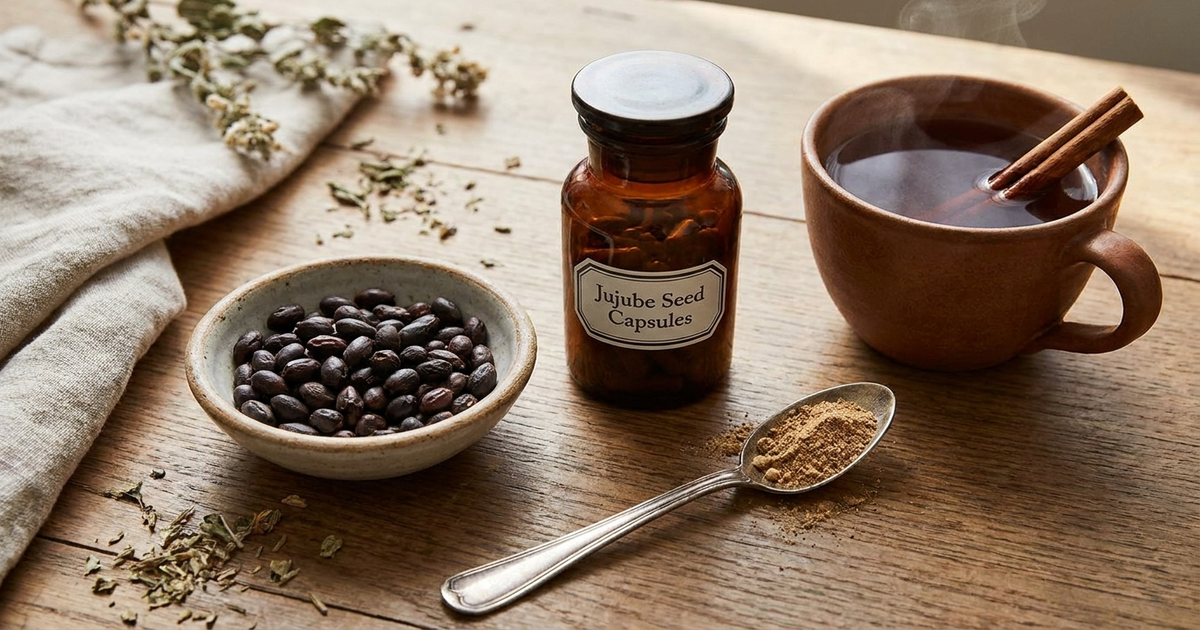
The answer depends on the form. Traditional references give 9–15 g of whole seed as a decoction, 3–5 g as powder or pills, and supplement sellers give 300–600 mg of extract. The best-documented single-herb human trial used 250 mg capsules twice a day for 21 days. No source I found sets a clinical standard dose, so treat every number below as a published range, not a prescription. This is the seed of Ziziphus jujuba var. spinosa (suan zao ren), not the sweet red jujube fruit (da zao) sold as dates or date tea.
By Chester Takau · November 2026
Published range by preparation
Dose by preparation: why the numbers disagree
A gram of whole seed, a gram of powder and a milligram of standardized extract are not interchangeable, and no source I found gives a validated conversion between them. The table lines up the ranges as published. It is my own summary of the sources below, not a conversion chart.
| Preparation | Published range | Source type | Evidence behind it |
|---|---|---|---|
| Whole seed, decoction | 9–15 g; up to 30 g supervised | TCM herb references | Tradition; no single-herb trial of this form found |
| Whole seed, food therapy | 10–15 g (porridge 15 g, tea 10 g, soup 15 g) | Nspirement, May 2026 | Cites no studies; calls human trial quality “mixed” |
| Powder or pills | 3–5 g | TCM herb references | Tradition |
| Capsule | 250 mg twice a day, 21 days | Double-blind RCT, postmenopausal women | One trial, one population |
| Standardized extract | 300–600 mg (2% jujubosides), 30–45 min before bed | Seralene supplement guide, Oct 2026 | Commercial source, self-rated “Grade C: Emerging”; mechanism claims unsourced |
| Liquid seed extract or mixture | 100 mL, 30 min before bed, 28 days | 2026 Frontiers in Food Science and Technology trial | 25 participants; no mg dose stated |
Concentrates sold as “20:1” add another layer, since the label ratio describes how much raw seed went into the extract, not how much active compound you get. I found no source that translates it to a dose.
Raw or roasted, whole or crushed?
Nspirement says the seeds are usually dry-fried lightly before use. A long-running classical view, relayed by the same source, gives raw seed for excess sleepiness and roasted (chao) seed for insomnia, so for sleep the roasted form is the traditional choice. I found no trial that compared raw with roasted. Whether to crush the seed before simmering is mentioned traditionally but never explained in the sources I read, so I will not offer a rule for it.
What do trials say about timing and results?
The two human trials I could find on the seed alone ran 21 and 28 days, with doses taken about 30 minutes before bed in the 28-day one. The 28-day trial (Lee, Lee, Byeon and Hwang, April 2026) had 25 participants. Their PSQI score fell from about 13.4 to 7.9 and sleep latency fell from about 54 to 30 minutes. Total sleep time did not change, the paper reports no significant between-group difference, and the control group received nothing rather than a placebo. Weekly bowel movements also increased.
A realistic expectation from that one small trial is falling asleep faster over several weeks, not sleeping longer. It is not enough to promise either.
How strong is the evidence?
- Single seed: thin. A 2020 postmenopausal RCT and the 2026 n=25 trial. A 2026 Food Bioscience review says most of the health evidence comes from animal and in-vitro work, and a separate 2026 study found jujuboside A reduced insomnia and anxiety-like behavior in mice.
- Five-herb Suan Zao Ren Tang: larger, but mostly from Asia and of variable quality. Memorial Sloan Kettering (updated 30 July 2026) notes a meta-analysis with short-term sleep-quality gains comparable to benzodiazepines or CBT, with larger trials still needed. A July 2026 mouse study found Suanzaoren Decoction and Suanzao Decoction had similar anti-insomnia effects, which is animal data on a formula.
- The skeptic's view: Examine.com says a systematic review could not draw conclusions about efficacy in humans.
- “Beats lorazepam” claims: the 2015 trial tested the formula combined with Zhi Zi Chi Tang in insomniacs with anxiety, and MSKCC frames the result as an add-on benefit. It says nothing about the seed alone.
Who it suits, and who should be careful
Practitioners say it fits deficiency-type insomnia, which in plainer terms is the tired-but-wired pattern: racing mind, dream-disturbed sleep, sometimes palpitations. They say it does not fit excess heat or phlegm patterns. That is a traditional diagnosis, not something a trial has tested, and it argues against treating the seed as a one-size-fits-all supplement.
- Reported side effects (MSKCC, for the formula): dizziness, dry mouth, rash, constipation or diarrhea, fatigue and sleep disruption. The oily seed may loosen stools in people with weak digestion, according to a secondhand review-site report.
- Antidepressants: MSKCC lists possible interactions with SSRIs/SRIs and MAOIs, including a case report raising concern about serotonin syndrome. Ask a pharmacist before combining it with any antidepressant.
- Other sedatives and alcohol: I found no interaction trials. Because of that gap, stacking sedating products is the cautious thing to avoid; check with a doctor or pharmacist before combining them.
- Pregnancy: data are insufficient.
If you are comparing options, the seed is one of several herbs with limited data. What wild lettuce is for sleep covers one with no human sleep trial at all.
A video explainer
Doctor Yang's single-herb video is the most recent one I found on the seed itself. I could not retrieve its transcript or confirm the channel's credentials, so watch it as an overview and check any dose it mentions against the table above.
FAQ
Is jujube tea the same as suan zao ren?
No. Most jujube tea uses the sweet red fruit. Suan zao ren is the seed of the sour jujube, and the sleep research is on the seed.
Does jujube seed make you sleepy?
Reviewers describe a gentle effect with less morning grogginess than melatonin or antihistamines, but those reports are secondhand and unverified. The 28-day trial found faster sleep onset, not longer sleep.
How long before bed should I take it?
The 2026 trial gave the drink 30 minutes before bed, and one supplement seller suggests 30–45 minutes for extract. Neither is a clinical rule.
Is it safe with SSRIs or sleep medication?
MSKCC flags possible interactions with SSRIs/SRIs and MAOIs. Ask a pharmacist before combining it with any prescription.
Sources
- Frontiers in Food Science and Technology (2026): 28-day seed extract trial
- Double-blind RCT: jujube seed capsule, 250 mg twice daily for 21 days
- MSKCC: Suan Zao Ren Tang monograph (updated 30 July 2026)
- 2015 RCT: Suan Zao Ren Tang plus Zhi Zi Chi Tang vs. lorazepam
- Placebo-controlled RCT: Suan Zao Ren Tang in methadone maintenance
- Nspirement, 29 May 2026: sour jujube seeds, preparation and recipes
- Seralene: supplement guide (commercial source)
- 5000yan: sour jujube seed, TCM dosage
- Examine.com: jujube research summary
- Food Bioscience (2026): sour jujube seed review and jujuboside A mouse study
- Me & Qi: suan zao ren and pattern diagnosis
- Nighttime Comfort: user reports (secondhand)
Updated November 2026. General information, not medical advice. The table is the author's own summary of published ranges, not a validated dose conversion. I could not open the PDF text of the July 2026 mouse study or the video transcript.
Transparency note: This article was researched and written by Chester Takau with AI assistance for research gathering and drafting. All recommendations reflect the author's own editorial judgment.
Comments
Post a Comment