Does GABA Cross the Blood Brain Barrier? What the Evidence Shows
Does GABA Cross the Blood Brain Barrier? What the Evidence Shows
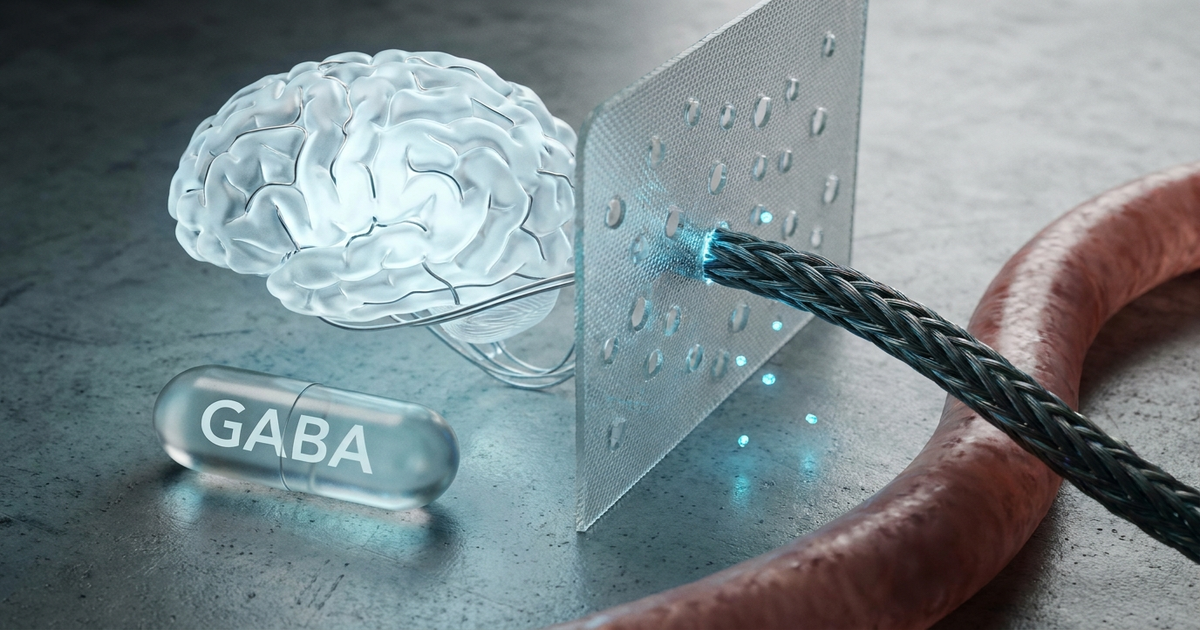
Probably only in small amounts, and nobody has shown it in people. Early studies mostly found that GABA does not cross the blood-brain barrier. Later animal work found tiny amounts getting through, and the most-cited review (Boonstra et al., 2015) calls the data "often contradictory." As of late 2026 I found no human brain-imaging study showing that oral GABA raises GABA inside the brain. A trial that could answer it directly (NCT06464172) has no posted results.
By Chester Takau · November 2026
What happens to a GABA capsule after you swallow it
Most pages stop at "it doesn't cross." The fuller picture has steps, and the evidence is stronger for some than others.
- Absorption. GABA does reach the blood. In a pharmacokinetic study of 12 volunteers (Li et al., 2015), blood levels peaked 0.5 to 1 hour after dosing and the half-life was about 5 hours.
- The barrier. GABA carries a charge, which is why skeptics call it "too polar" to pass easily. Boonstra and colleagues note that several studies still reported small amounts crossing, with widely varying methods.
- Removal. McGill's Office for Science and Society points out that GABA that does get in may simply be "removed from it very rapidly," which would make it hard to measure and hard to benefit from.
Wikipedia captures the shift: the old view was that supplemental GABA does not cross, but rat research in the 2010s left the question "unclear." A 2025 mouse study reportedly found higher prefrontal GABA after oral dosing, but according to secondary summaries its authors stopped short of claiming direct passage through the barrier.
If it doesn't cross, why do some people feel sleepy?
Three explanations are in play, and they are not exclusive.
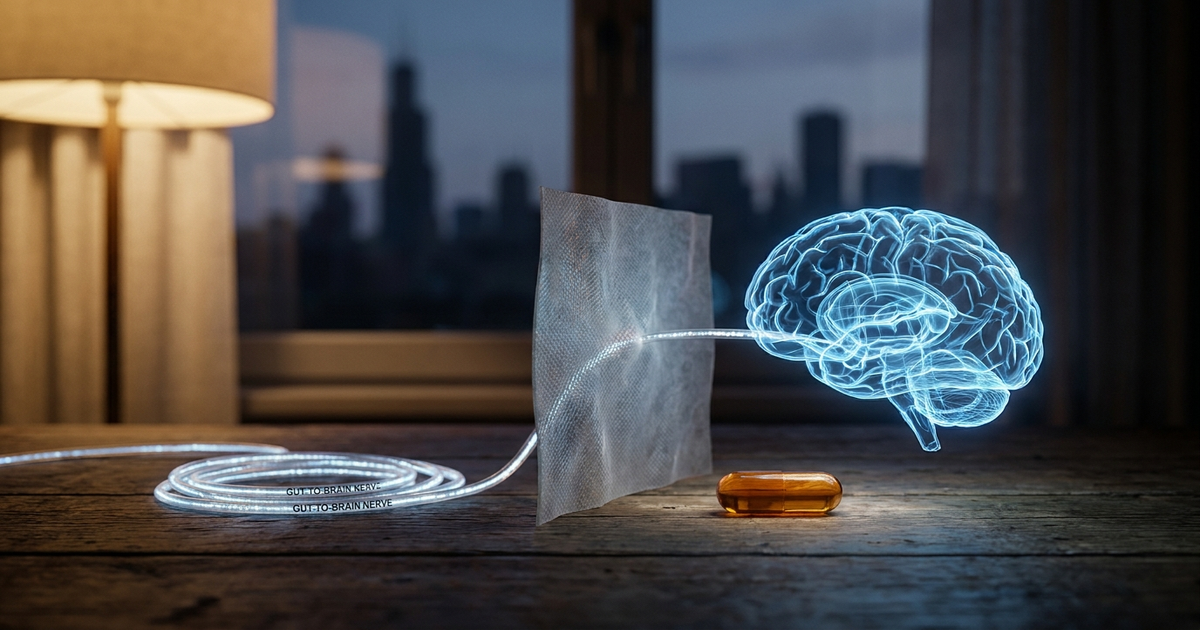
The gut route. A 2026 Nutrients review on GABA as a functional nutrient lists vagus-nerve activation and gut GLP-1 release as proposed mechanisms, but those rest on animal and cell models. There is human data that oral GABA does something in the gut: a May 2026 crossover pilot in 20 people with diarrhea-type IBS (18 finished) found a clinical response in 66.7% on GABA versus 33.3% on placebo, with a significant drop in IL-1β (p = 0.02). That is small, and it says nothing about sleep. It does show an effect without needing brain entry. The vagus nerve connects gut and brain, which is why this route keeps coming up.
Other ingredients and expectation. In the Reddit threads I read, some commenters credit the magnesium taken alongside GABA for the calm. Placebo response is also real in small sleep trials.
A little gets in. If small amounts do cross, even a modest effect is possible. This is the part nobody has settled.
One claim to treat carefully: the supplement brand Troscriptions argues that feeling GABA's effects means you have a leaky barrier. That comes from a company selling an alternative product, and I found no neutral source supporting it.
Thomas DeLauer covers this in the "Do GABA Supplements Work?" chapter, starting around 02:34. After describing animal injection studies, he says:
"we have not seen this replicated in humans" … "so we cannot say yes or no Gaba supplements get into the brain"
Quote note: the words come from an auto-caption transcript on a third-party mirror, and I could not check them against the audio. The video is from 2024, and DeLauer is a nutrition creator, not a researcher.
GABA versus compounds that do cross
People often ask why phenibut, gabapentin, baclofen and picamilon work on the brain when GABA supposedly doesn't (the question McGill's explainer addresses). They are different molecules, built or modified in ways that change how they interact with the barrier.
| Compound | Reaches the brain? | Note |
|---|---|---|
| Oral GABA | Unresolved | Contradictory animal data; no human brain-imaging proof |
| Phenibut | Cited as crossing | Carries risks and regulatory issues; not a sleep supplement to casually try |
| Gabapentin, baclofen | Cited as crossing | Prescription drugs; OTC GABA is not a substitute, so ask your prescriber before stopping one |
| Picamilon | Cited as crossing | GABA bonded to niacin; regulatory status varies, so check locally |
Herbs are a separate case. Plants such as skullcap are discussed for calming effects through other pathways; our explainer on what skullcap herb is and how American and Chinese skullcap differ covers what is and is not known there.
How good is the sleep evidence?
Modest. A 2020 systematic review (Hepsomali et al.) found "limited evidence for stress and very limited evidence for sleep." The positive sleep trials are small, mostly Japanese and often industry-funded; the key Yamatsu 2016 trial had about 10 subjects. Whether a product is fermented (such as PharmaGABA) or synthetic is rarely compared head to head, and I found no independent evidence that liposomal or "nano" GABA crosses better.
What could settle it
Université de Sherbrooke registered NCT06464172, with 30 participants. It measures serum GABA and TMS short-interval cortical inhibition 40 minutes after oral GABA versus placebo, which is a direct test of whether oral GABA changes brain activity. The estimated primary completion date was May 2026, but the registry was last updated February 2025 and listed it as "not yet recruiting." I found no results.
Frequently asked questions
Does feeling GABA's effects mean my barrier is leaky?
No neutral source supports that. The claim comes from brand content. Gut and nerve effects, other ingredients and expectation are simpler explanations.
Is GABA safe to take?
A 2026 rat study found no reproductive or developmental toxicity from repeated oral GABA. That is useful context but not human long-term safety data, and it does not address the barrier. People ask about tolerance and rebound anxiety, and I found no good data on either. If you take sedating medication, ask a pharmacist first.
Does liposomal GABA cross better?
I found no independent evidence either way.
Sources
- Boonstra et al., Frontiers in Psychology, 2015
- Hepsomali et al., Frontiers in Neuroscience, 2020: oral GABA for stress and sleep
- Nutrients, 2026: Supplementation of γ-Aminobutyric Acid as a Functional Nutrient
- Nutrients, 2026: GABA pilot trial in diarrhea-type IBS
- McGill Office for Science and Society: GABA supplements
- Superpower guide: GABA for sleep and the blood-brain barrier (updated Oct 2026)
- ClinicalTrials.gov NCT06464172
- Wikipedia: GABA
Updated November 2026. Reddit threads were read through a snapshot mirror, so post dates are estimates.
Transparency note: This article was researched and written by Chester Takau with AI assistance for research gathering and drafting. All recommendations reflect the author's own editorial judgment.